It is by living there from day to day that you feel the fullness of her charm; that you invite her exquisite influence to sink into your spirit. The creature varies like a nervous woman, whom you know only when you know all the aspects of her beauty. Henry James, Italian Hours, 1909
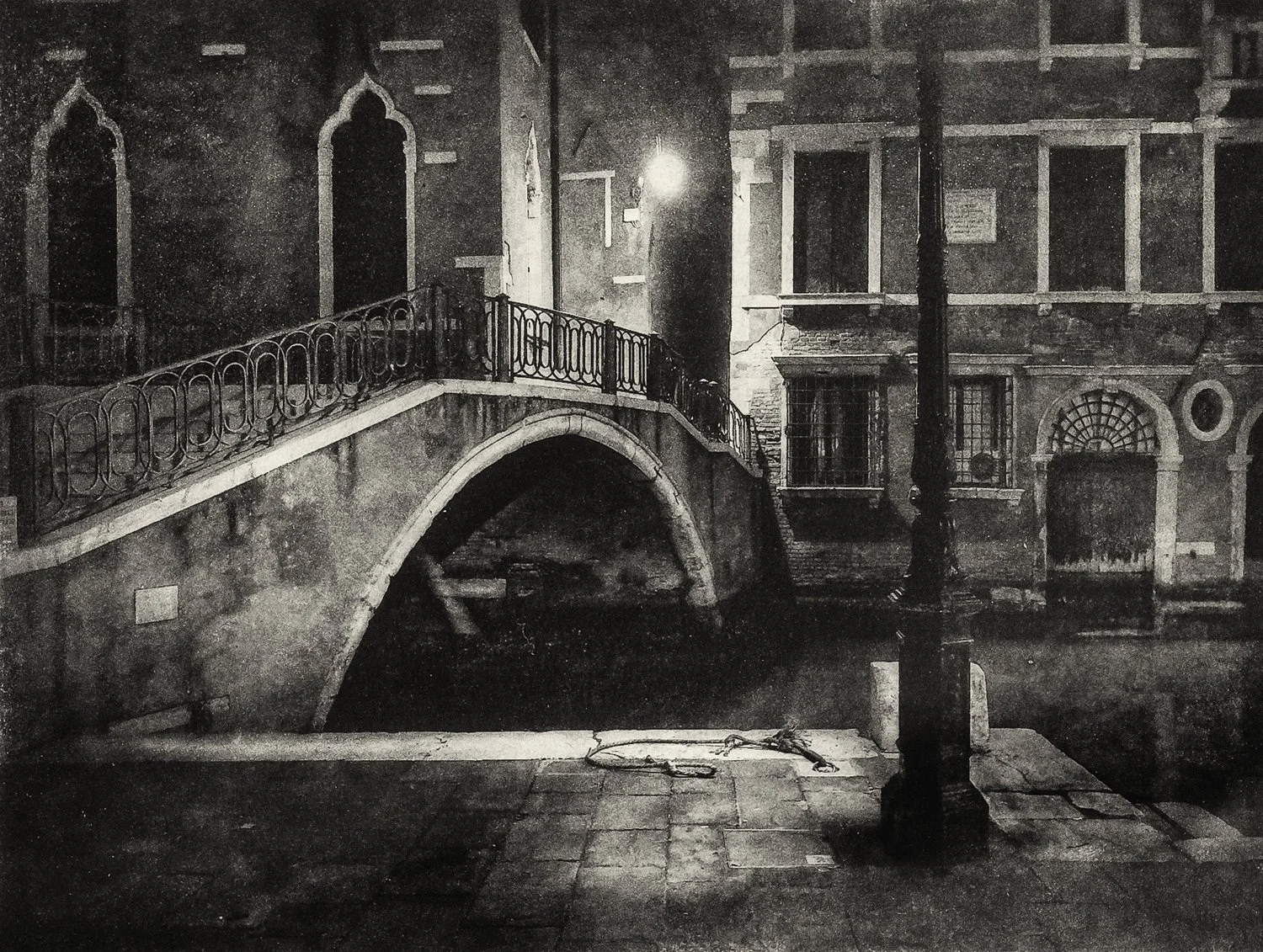
Brian Nelson. Photogravure. Venice, Italy. 2019.
Six months before I left on two trips to Venice in the Spring of 2019, I read a volume of essays and reminiscences of Venice by Henry James that featured several etchings by James MacNeil Whistler. One of the etches depicted an impressive structure built along a bend in a canal, and seeing it inspired me to return to Venice to see if I could find it. The etching was Whistler’s favorite of all his Venice works.
Because Henry James’ writings provided no clue as to the location of the building, I studied a map of Venice, looking for bends in canals where Whistler might have sketched the building. I targeted a spot not far from Marco Polo’s home. I thought I might be able to see the building from the opposite side of the canal. Whistler often sketched while seated in a gondola, in which case I might not find a vantage point. Further problematic was that my map had labels, orange lines, and folds that obscured details in the neighborhood I was going to explore.
Venice is so compact, having narrow passageways, odd turns, half-hidden courtyards, and dead ends. If one is completely lost, a reasonable way to navigate the streets is to take all right turns or all left turns to find your way. Indeed, this navigational method brought me to the vantage point I was looking for, giving me a clear view of the building located on a bend in the canal. Its architectural details were not identical, but very similar to Whistler’s. Since Whistler’s etchings generally bear resemblances to sites rather than precise depictions, I regard his rendition of the site I found as a prime example of Whistler’s imaginative prowess.
I was still wandering through the neighborhood with my full regalia of camera gear, when just after rounding another corner, a Venetian approached me and started a conversation with me about the dilapidated condition of American cities and that it was time something was done about it. After a few minutes of listening, I asked him about the brass squares I’d seen nearby that are embedded into the pavement. On the squares are inscribed the names of former Jewish residents who’d been dragged off to Auschwitz. It was a friendly exchange between political opposites, and he commented toward the end that wandering through the streets as I was doing was a fine way to see interesting features of Venice.
Brian Nelson is a member of the Art Junket (2017-2022)