
Geometric figures - Art with Franky Lee
The solids combine with themselves and with each other to give rise to endless complexities, which anyone who is to give a likely account of reality must survey. Plato, The Timaeus dialogues, ~360 B.C.E.
“I haven’t created anything with my hands for a very long time. When I was a kid, my mom and dad got me origami books. There were two large volumes. At the end, the most difficult origami were the modular origami.Taking one root piece, you replicated it many times and created giant three dimensional shapes. Taking the ‘Roots’ theme from the Art Junket, I took the idea that there would be one ‘root’ that shared and created many things from it.There are five Platonic solids. They are geometric figures. The faces are all equilateral. They are all equilateral triangles, squares, or pentagons.” (Frankie Lee, Member of Art Junket East, 2019)

Franky Lee
Plato wrote about these solids in the dialogue Timaeus c.360 B.C.E. in which he associated each of the four classical elements (earth, air, water, and fire) with a regular solid.
Earth was associated with the cube, air with the octahedron, water with the icosahedron, and fire with the tetrahedron. There was intuitive justification for these associations: the heat of fire feels sharp and stabbing (like little tetrahedra). Air is made of the octahedron; its minuscule components are so smooth that one can barely feel it.
Water, the icosahedron, flows out of one's hand when picked up, as if it is made of tiny little balls. By contrast, a highly non-spherical solid, the hexahedron (cube) represents “earth". This clumsy little solid cause dirt to crumble and break when picked up.
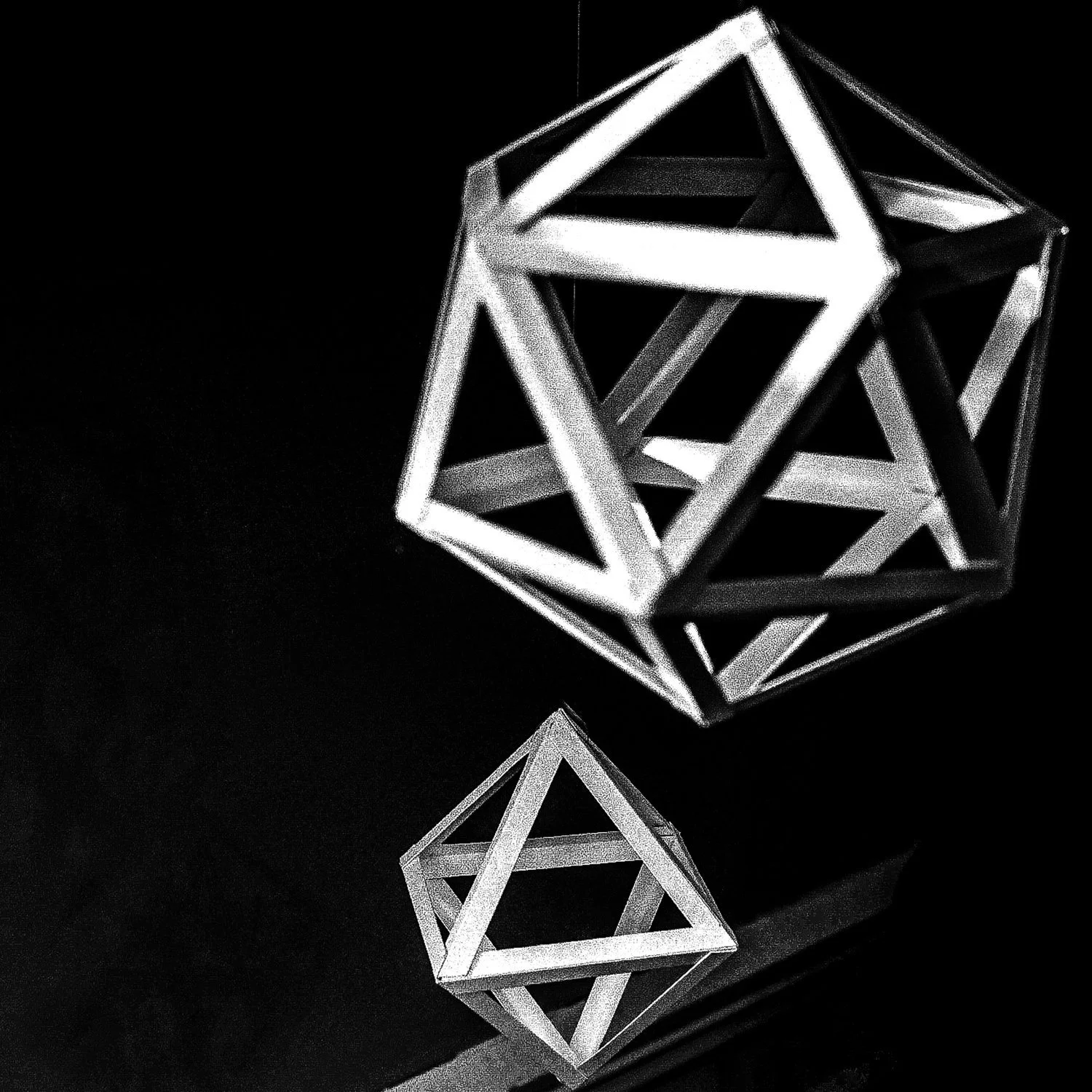
Of the fifth Platonic solid, the dodecahedron, Plato said, "...the god used it for arranging the constellations in the heavens.” (Wikipedia )
The tetrahedron - 4 triangular sides.
The cube/hexahedron - 6 square sides.
The octahedron - 8 triangular sides.
The dodecahedron - 12 triangular sides.
The icosahedron - 20 triangular sides.
Leonardo da Vinci was the first to draw Platonic solids as see-through figures. He drew the figures for his math tutor, Pacioli’s for Divina Proportione. Those sixty drawings are the only drawings da Vinci published in his lifetime. Da Vinci’s studies with Pacioli led to lifetime interest in mathematics and geometric shapes.
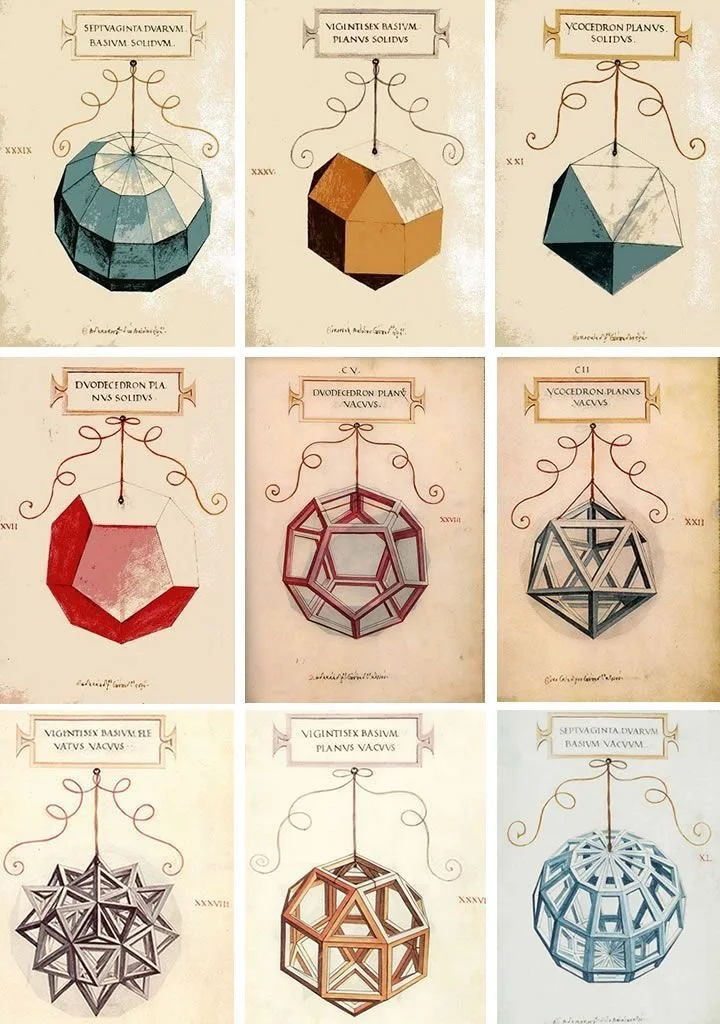
Leonardo da Vinci. Platonic Solids. 1492.
Art and words: Frankie Lee
Frankie Lee is a member of the Art Junket East.
Photos and words: Maureen Fitzmahan